

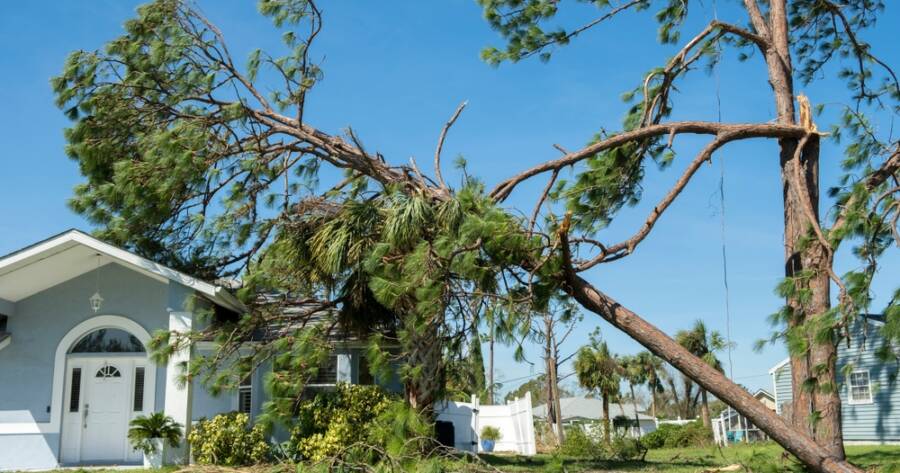
When a tree falls after a storm or simply needs to come down, the question of who owns it—and who pays for its removal—can quickly become complicated. Understanding property boundaries, insurance coverage, and potential liability can help homeowners determine their responsibilities and avoid costly disputes.
Who Actually Owns the Tree?
In many states, determining who owns a tree begins with identifying where its trunk meets the ground. A tree growing entirely within one property generally belongs to that landowner, even when its branches or roots extend into a neighboring yard. However, property agreements and state-specific laws can affect ownership, making it important to confirm the applicable rules before undertaking major tree work.
When a trunk straddles the boundary line between two properties, the situation changes. That tree is considered jointly owned by both neighboring property owners, making both parties responsible for decisions about its care, maintenance, and removal (source). Importantly, any homeowner planning to remove a shared boundary-line tree should first consult with the co-owner to avoid potential civil or criminal penalties and to settle questions about how and by whom removal costs will be split (source).
Storm Damage and the Default Rule on Liability
After severe weather tears through a neighborhood, downed trees and broken limbs often lead to immediate questions about fault. Under the default legal standard applied in most states, a property owner is generally not held liable when a healthy tree falls due to natural causes like high winds or a lightning strike (source). The reasoning is straightforward: unpredictable weather events fall outside the reasonable control of any individual homeowner.
This default protection, however, has a significant exception rooted in the concept of negligence. If a tree was visibly dead, diseased, or in obvious decline—and the owner either received warnings or reasonably should have recognized the danger—liability may shift to that owner when the tree eventually causes damage (source). This principle becomes especially important when a hazardous tree sits adjacent to a public road or sidewalk, where the law applies stricter expectations on owners to address known dangers (source).
How Homeowners Insurance Fits Into the Picture
Most people assume that if a neighbor’s tree falls onto their property, the neighbor’s insurance pays. In practice, that is rarely how it works. The standard approach is for the property owner who suffers the damage to file a claim with their own homeowners insurance—regardless of which yard the tree was rooted in (source). This means a homeowner whose fence or roof is crushed by a tree from next door will typically look to their own policy first, not their neighbor’s.
Tree removal coverage under a standard homeowners policy is often limited. Homeowners insurance may help pay for removing a fallen tree when it damages an insured structure, although coverage depends on the policy and circumstances of the loss. Some policies impose separate limits on debris removal, while others provide additional coverage when a tree blocks a driveway or accessibility route. If a tree falls harmlessly in the yard, the homeowner may have to cover removal expenses independently.
Reviewing the policy’s exclusions, deductibles, and debris removal provisions is essential (source). Homeowners should review their specific policies carefully, since coverage for debris removal alone—without structural damage—can be far more restricted.
When negligence is established, the calculus can shift. A neighbor who knowingly ignored a deteriorating tree that eventually caused damage may face financial responsibility beyond what insurance would normally cover (source). Documentation matters in these cases: prior written notices, photographs of the tree’s condition, and any communication about the hazard can all play a role in determining who ultimately bears the financial burden.
Stump Grinding and Cleanup After Removal
Tree removal rarely ends with the tree hitting the ground. Stumps left behind can be eyesores, potential tripping hazards, and even sources of continued root encroachment. After a tree is removed, the remaining stump may require additional work. Whether stump grinding is necessary depends on its location, potential hazards, and the property owner’s plans for the area.
Homeowners commonly arrange and pay for stump removal on their own land, although insurance coverage, local requirements, or agreements between neighbors may affect responsibility. When removing a jointly owned boundary tree, discussing stump grinding and cleanup costs beforehand can prevent disagreements (source).
When a tree falls onto neighboring property, the affected homeowner often arranges the initial cleanup and contacts their insurer about possible coverage. However, responsibility for the final expense may depend on whether negligence contributed to the damage, who owns the tree, and applicable local laws. Trees affecting public roads or sidewalks may also involve municipal authorities.
Homeowners should confirm these responsibilities before undertaking major removal work (source). Municipal regulations in some areas may place additional obligations on homeowners for trees that fall into public rights-of-way or onto street infrastructure, making it worthwhile to check local ordinances alongside insurance policies.
Practical Steps for Property Owners
Proactively managing trees is one of the most effective ways to limit liability and avoid disputes. Having a certified arborist assess trees periodically—particularly large or aging specimens—creates a record of reasonable care and can identify risks before they become emergencies. If a potentially hazardous tree is spotted on a neighboring property, sending a written notice to that neighbor documents awareness and may later serve as evidence that the owner had been informed of the danger.
For boundary-line trees, any significant work—pruning, removal, or major treatment—should involve both co-owners from the start. Reaching a written agreement that addresses costs, the timeline for work, and which professional will perform the job helps prevent legal disputes down the road. When storm damage has already occurred, homeowners should photograph the scene thoroughly before any cleanup begins, as that documentation can support both insurance claims and any potential negligence arguments.
Why You Should Learn More About Tree Ownership and Liability
Knowing where legal responsibility begins and ends for trees on or near a property is essential knowledge for any homeowner. Whether the situation involves storm cleanup, a shared boundary tree, or a long-neglected stump, the same core principles apply: ownership follows the trunk, negligence shifts liability, and insurance tends to favor the property where damage occurred.
Taking a proactive approach—through regular tree assessments, clear communication with neighbors, and a thorough understanding of homeowners insurance coverage—puts homeowners in the best position to handle any tree-related situation that arises. Consulting with a qualified tree service professional and, when legal disputes are possible, a licensed attorney, can make navigating these issues significantly less stressful.