

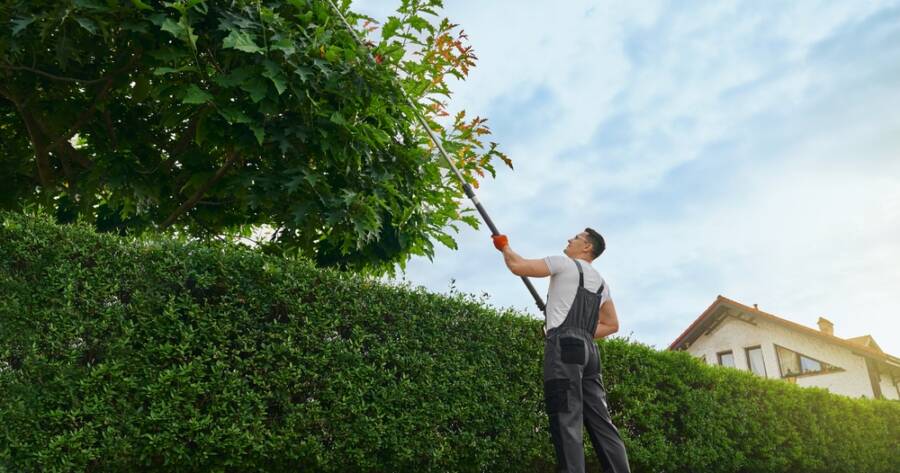
Professional tree services help cities and neighborhoods maintain trees as healthy, functional parts of the built environment. Proper pruning, diagnosis, planting, soil care, and hazard management can protect mature trees while reducing risks to people, buildings, roads, and utilities. Well-maintained urban trees also contribute shade, stormwater management, visual appeal, and other environmental benefits, making professional tree care an important part of community life.
Improve Tree Health and Structure
Routine tree care can correct structural problems before they become more serious. Professional pruning may remove dead, damaged, diseased, or poorly positioned branches while improving the overall structure of the canopy. Strategic pruning can also reduce conflicts with buildings, streets, sidewalks, and other infrastructure without unnecessarily removing a healthy tree (source).
Tree services can also identify problems that are difficult for property owners to diagnose independently. Symptoms such as thinning foliage, abnormal leaf color, dieback, cracking, fungal growth, or premature leaf drop may indicate pests, disease, root damage, soil problems, or environmental stress. Early identification gives property owners and municipalities more options for managing a problem before the tree declines substantially.
Make Streets and Properties Safer
Trees can become safety concerns when branches are dead, trunks are weakened, roots are compromised, or structural defects increase the likelihood of failure. Professional assessment can identify hazards and determine whether pruning, cabling, treatment, monitoring, or removal is appropriate. Removing a dangerous branch before it falls can protect pedestrians, parked vehicles, roofs, and nearby utility lines (source).
Safety-focused tree care is particularly important in dense urban areas because trees often grow close to homes, roads, parking areas, playgrounds, and public walkways. The goal is not simply to remove large trees whenever risk exists. Good tree management balances public safety with the value of preserving established trees whenever defects can be addressed responsibly.
Preserve Shade and Reduce Urban Heat
Healthy tree canopies provide shade for streets, sidewalks, buildings, parking areas, and public spaces. Shade can make outdoor environments more comfortable while reducing the amount of solar energy absorbed by pavement and other hard surfaces. Trees also release water vapor through evapotranspiration, which contributes to cooling in developed areas (source).
Professional tree services help preserve these benefits by maintaining mature trees, correcting avoidable problems, and replacing trees when removal becomes necessary. Appropriate species selection and planting location are especially important. A tree suited to the available soil, climate, overhead clearance, and surrounding infrastructure is more likely to develop successfully without creating unnecessary conflicts later.
Support Stormwater Management and Urban Ecology
Urban trees can intercept rainfall before it reaches streets and storm drains, while roots and surrounding soil can help absorb and manage water. These functions make trees useful components of green infrastructure, particularly in heavily developed areas dominated by roofs, roads, sidewalks, and parking lots (source).
Tree-care professionals can support these functions by protecting root zones, addressing compacted soil, improving planting conditions, and avoiding unnecessary damage during maintenance. Healthy trees can also contribute habitat and food resources for wildlife while strengthening the broader network of vegetation within neighborhoods and commercial areas. Maintaining individual trees therefore supports environmental functions that extend beyond a single property.
Avoid Harmful Tree-Care Practices
Poor maintenance can undermine many of the benefits urban trees provide. Topping, excessive pruning, root damage, inappropriate watering, and badly placed cuts can weaken trees or encourage structural problems. Professional pruning follows established arboricultural principles rather than simply removing large portions of the canopy to make a tree smaller (source).
Tree services can also help property owners understand when intervention is actually necessary. Not every tree requires frequent pruning, and unnecessary work can create new problems. An experienced professional can recommend maintenance according to the tree’s species, age, condition, location, and surrounding land use rather than applying the same treatment to every tree.
Enhance the Appearance of Neighborhoods and Public Spaces
Trees strongly influence how streets, parks, residential areas, and commercial districts look and feel. Healthy canopies can soften hard architectural surfaces, create attractive streetscapes, frame buildings, and make outdoor spaces more inviting. Neglected trees with dead limbs, severe dieback, or poor structure can have the opposite effect.
Professional maintenance helps retain the natural form of trees while addressing branches or growth patterns that interfere with surrounding spaces. When combined with thoughtful planting and long-term care, these services can create more consistent, attractive landscapes without sacrificing tree health merely for short-term appearance.
Why Tree Services Matter in Urban Landscapes
Tree services enhance urban landscapes by doing much more than trimming branches or removing unwanted trees. They help preserve healthy canopy, identify disease and structural problems, reduce hazards, support appropriate planting, and protect the environmental functions mature trees provide. These actions allow trees to coexist more successfully with buildings, transportation networks, utilities, and heavily used public spaces.
The greatest value often comes from maintaining healthy trees before problems become severe. With appropriate care, urban trees can continue providing shade, stormwater benefits, visual character, and safer outdoor environments for years. Professional tree management therefore supports both individual properties and the wider health and appearance of urban communities.